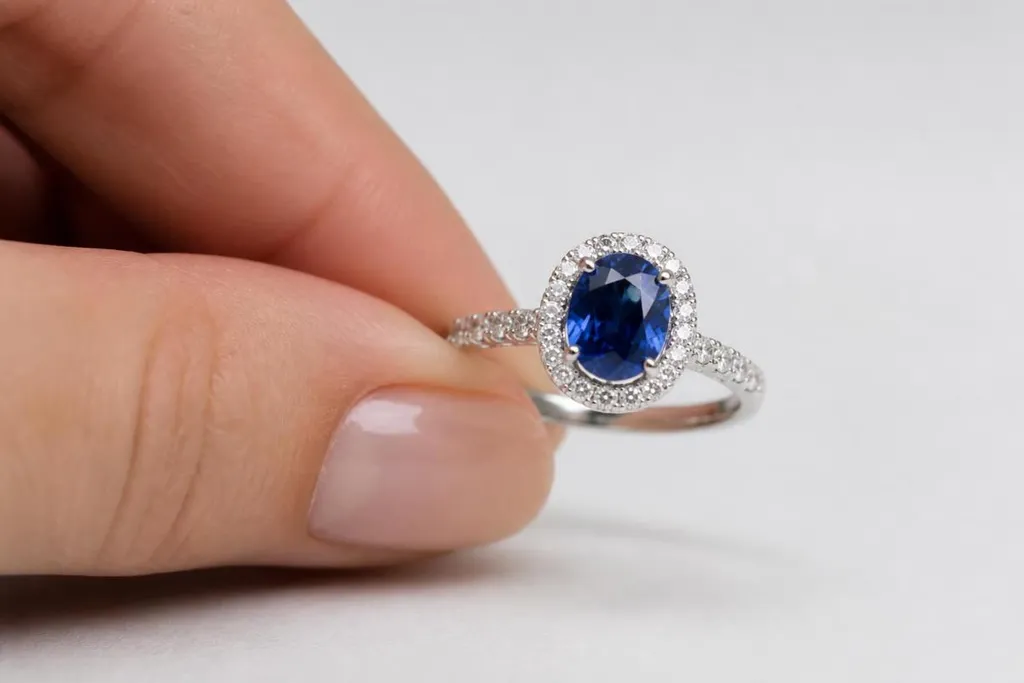
Few engagement-ring combinations create contrast as confidently as a deep blue sapphire surrounded by bright diamonds. The sapphire supplies rich colour and a distinctive focal point, while the halo intensifies its outline with light. Set in 18k white gold, the surrounding structure remains cool and visually restrained, allowing the relationship between blue and white to define the ring. It is a classic formula, yet careful proportions keep it feeling relevant rather than overly traditional.
For someone drawn to this style, the option to order the white gold Diana ring from Lily Arkwright demonstrates how a blue sapphire, lab diamond halo and 18k white gold setting can work as one composition. The appeal is not simply the amount of sparkle; it comes from balancing a strongly coloured centre stone with a bright surrounding frame.
Why Blue Sapphire Works So Well in a Halo
A coloured centre stone behaves differently from a colourless diamond. Rather than relying primarily on brilliance, a blue sapphire draws attention through hue, saturation and contrast.
A diamond halo can strengthen that effect. The surrounding white stones create a bright boundary around the sapphire, making its blue colour appear particularly pronounced. This is one reason the combination remains so recognisable in fine jewellery.
Proportion is important, however. A substantial halo around a relatively small centre stone can make the overall ring look more diamond-led than sapphire-led. A larger sapphire creates a stronger area of uninterrupted colour and keeps the gemstone clearly dominant.
Someone may therefore choose a more generous centre stone not simply because they want a larger ring, but because they want blue to remain the defining visual element.
The shape and spacing of the halo matter too. A closely fitted arrangement can emphasise the sapphire's outline, while excessive space between the centre and surrounding diamonds may make the elements feel disconnected.
How 18k White Gold Supports the Colour Contrast
White gold is particularly effective in this design because it does not introduce another strong colour beside the sapphire.
Its bright, cool-toned appearance sits naturally with the lab diamonds in the halo. From normal viewing distance, the metal can visually recede between the smaller stones, creating a relatively continuous frame of brightness around the blue centre.
Yellow or rose gold would produce a warmer and more contrasting composition. That can be beautiful, but it changes the emphasis by making the metal itself a prominent part of the colour palette. White gold keeps the scheme focused on blue sapphire and white diamonds.
This also gives the ring considerable styling flexibility. It coordinates naturally with white-metal earrings, necklaces and wedding bands, as well as many watch finishes.
White gold does require some ongoing care. Its bright white surface is commonly maintained with rhodium plating, which may gradually wear depending on how frequently and intensively the ring is worn. Professional replating can refresh the finish when needed.
Balancing Halo Sparkle With the Centre Stone
A halo should enhance the sapphire rather than obscure its individuality.
Small lab diamonds provide enough contrast to define the centre while allowing its colour to remain uninterrupted. The eye should register the blue sapphire first and the surrounding brilliance second.
This distinction becomes especially important if additional diamond detailing appears elsewhere on the ring. Too many equally strong areas of sparkle can reduce the visual hierarchy that makes a halo design successful.
The centre sapphire's proportions also influence how the complete ring sits on the hand. A larger gemstone and halo create broader finger coverage, which can feel appropriately substantial on a larger hand. Someone who prefers finer jewellery may instead choose more restrained dimensions to keep the halo elegant rather than dominant.
The best result is not necessarily the largest combination, but the one in which colour, brilliance and overall scale feel deliberately balanced.
Wedding-Band Pairing and Everyday Care
A sapphire halo ring already has significant visual character, so its wedding band can take several directions.
A plain 18k white gold band provides a clean contrast and allows the engagement ring to remain the main feature. A fine diamond-set band can extend the sparkle while maintaining the cool white-metal palette.
The halo's profile should be considered before choosing the wedding ring. Depending on how the centre setting is constructed, a straight band may sit flush or leave a small gap. A shaped band can follow the engagement ring more closely if a fitted appearance is preferred.
Regular cleaning is useful because residue can collect around both the sapphire and the smaller halo diamonds. Periodic professional checks are also sensible to ensure the numerous small settings remain secure.
Final Thought
A blue sapphire halo in 18k white gold succeeds because each element has a clearly defined role. The sapphire provides rich, unmistakable colour; the lab diamonds create a luminous frame; and the white gold supports both without introducing unnecessary visual competition.
For someone who wants an engagement ring with more colour than a traditional diamond design but still values classic structure, this combination offers an enduring solution. Its beauty lies in contrast—deep blue against crisp white, framed in proportions that allow both colour and sparkle to be appreciated.